See part 1 here
Patrick Andendall
Without the threats of his enemies, keen to tear him down, it seems more than possible that Caesar would have found an alternative to marching his legions into Italy. But as Cicero’s speeches and career, and the episodes between him and Clodius, and Milo and Clodius, and Sulla and Marius (among others) would show, the politics of personal destruction in the post-Gracchi order would prove to be so destructive as to destroy the Republic. People that feel threatened often make more extreme decisions, have more extreme views. So it was that from Tiberius Gracchus down to Caesar, almost all of the major populares of Rome were threatened with political violence at least in part orchestrated by the optimates; this generated a mentality among reformers of extreme risk-taking which became a modus operandi. The gambling started with legislation under the Gracchi, but the chips came to be legions and the Republic itself in the days of Caesar. But a special blame must be assigned to the optimates leading the Senate: they compromised on virtually nothing from 133-49 B.C.E., daring someone to destroy the Republic in order to get even the most basic reforms that were wholly necessary passed. Caesar took them on their dare, but apparently tried to avoid doing so; but Cato and his ilk never let him sit easy, and made it clear they would do everything they could to tear him down for his “sins” of his consulship of 59. They did this to a man with a personal, veteran army, and they were willing to fight a civil war just to take him down. Caesar, for his part, let his own sense of self worth get in the way of working out a better deal with Pompeius, as did Pompeius with Caesar. Sadly, the stakes set by nearly a century of life-and-death struggle over basic governance left little room for alternative and too much risk for those thinking of compromise. It is important to note that Caesar generally offered clemency and eventual reinstatement to his opponents during and after the civil war, something unique among all the generals in Roman history who had seized power by force, for which Caesar was famous in his own lifetime, and something, it should be noted, his opponents would clearly not have shown him, except perhaps for Pompeius, and did not show him when many of these former opponents, pardoned by Caesar, assassinated him in the Senate. His successors, Octavian and Marcus Antonius, were not prone to the same clemency. Thisclemencia regularly offered by Caesar further adds to the argument that unlike his opponents, Caesar was conciliatory and willing to work with his opposition peacefully before the outbreak of hostilities. Furthermore, one must ask how different things would have been if Caesar had not been away from Rome for most of the 50s. His personality was exceedingly charming and he was able to boldly reconcile others throughout his career, notably Pompeius and Crassus twice, and even Pompeius and Clodius. With his record and skills of personal diplomacy, and the personality to make him excel so well at this, it is not unreasonable to speculate that, had Caesar spent more time away from his provinces in Rome in the 50s, like Pompeius did, the forces that pushed Rome to civil war might have been ameliorated just enough to prevent civil war. One might assume that there would have been a fairly good chance of his relationship with Pompeius not deteriorating as much as it eventually did, and one must remember that this was one of the final factors that led to open war. Though one cannot know such things, the point should be considered all the same. And, though even more speculative, it is certainly possible that Pompeius and Caesar working together for a much longer period of time might have peacefully reformed the Republic into something worth preserving, or at least with far less violence than ended up occurring. Instead, the real world outcome was massive bloodshed on a continental scale and the destruction of the Republic.
At the heart of the process leading to the end of the Republic was corruption, especially the corruption of the senatorial class/optimates and the publicani(Roman multinational corporations), but certainly also of the later populares, not terribly discriminating in their methods. There is the obvious material corruption, and the corruption of those seeking power, which, despite many attempts at reform and all sorts of legislation, proved ineffective abroad until Caesar’s reforms of his consulship for officials in the provinces and ineffective at home until Pompeius’s reforms during his second consulship, both just before the civil war between the two great men. As a class, the senators were atrocious; Cicero makes this more than clear in his prosecution of Verres, but Verres’s blatant guilt was one of the few instances that the senatorial class ever demonstrated even an inkling of a willingness to convict one of their own, unless personal vendettas or bribery were there to offer an incentive. For decades, senatorial elites abused their power to an extraordinarily extreme degree and thought nothing of it. Men like Lucullus and Rutilius paid a heavy price for their attempts to be fair and just and avoid corruption. Whenever their interests were seriously threatened, the publicani were able to buy off large portions of the Senate. This did not matter even if it hurt the interests of the state, as shown most blatantly in the cases of the pirates and the war with Mithridates. Without the senators, the publicani would not have been able to carry out their exploitation of the provinces, and without the publicani, it would have been much harder for the senatorial elite to pay off their campaign debts, and this relationship was a large source of the cash that ruined the extortion courts and elections.
But it is the corruption of the institutions of the Republic themselves which is perhaps most striking. Rather than use the rules, laws, and institutions as their creators intended, courts, Senate procedures, legislation, even armies became the tools of individual office holders to use to further their own individual interests and vendettas. This general abuse of governance ensured that the politics of personal destruction became inextricably woven into the fabric of the Republic itself. Prosecutions were rarely conducted, for example, to pursue justice; rather, they were a form of escalation in personal disputes, more often than not, between individual members of the ruling class. Procedures and rules in the Senate and in government, as demonstrated starkly by Cato’s filibustering, Bibulus’s use of interpreting religious omens, and the dispute between Metellus and the tribune that resulted in the Senate being convened in a jail, are only some of the examples. This is telling: for the senatorial elites; they were the Republic; their interests were the Republic’s. Before in Roman history, the interests of the state had tended to be the interests of the senators; but in the era discussed in this paper, the interests of the senators became the interests of the state. Even when good legislation and good magistrates were present, if the senators had a personal grievance against something or someone, or the people presenting the reforms or legislation were from a different class or rival faction, paralysis was the norm. Even Pompeius and Cicero found, for most of their careers, acceptance among the elite optimates almost impossible to attain, despite their many accomplishments, and despite their many attempts to ingratiate themselves to these eliteoptimates. First and foremost, then, the senators cared for themselves, and defined the Republic in terms of themselves. On the other side, populares leaders used their popularity so much to advance their programs that they themselves became synonymous with their agendas. Any personal blow to themselves had to be fought with every measure available, because their own personal failure meant that their causes would fail, too. In the high stakes game of politics in the Late Republic, this may have been true, with any reformer who did not cultivate public opinion as a check against the governing elites who would use violence against them appearing as too easy a target for that very violence; but often like theoptimates, populares put their own advancement at the head of their programs and accepted nothing less, risking their very lives and taking even more and more drastic measures in the face of senatorial threats and intransigence. The careers of Cicero, Pompeius and Caesar show how utterly futile it normally was searching for common ground with the optimates, however, lending some legitimacy to the view that it was the optimates who left men like Caesar little choice. The triumvirate, then, can be seen as a semi-peaceful attempt to sideline the fairly useless Senate from getting in the way of necessary reform, while also advancing the careers of the reformers and their supporters, to be sure; but taken too far, this would, and did, have the effect of destroying the Republic’s institutions, as the next level of escalation, on both sides, was the use of street gangs and, after that, armies, to achieve political aims. The stakes being what they were, neither the optimates nor the populares were willing to take a step back and avoid further escalation; doing so, because of the intensity of the politics of personal destruction, often meant that they risked prosecution, exile, or even death, though these risks seemed to be more true for the populares, who were generally not more than a few powerful men and their supporters who would face a Senate generally united behind the optimates or courts dominated by the same men and the publicani. Yet at the very end, the leading populares, men like Caesar and Clodius, had armies and gangs at their disposal, the only weapons they could use against a rigid opposition. The optimates, facing such powerful men, did not change their tactics but only intensified them; such behavior made a clash all but inevitable, and yet, if a few leading optimates had been able to go against the trend of initiating violence and selfish and partisan obstructionism, one can see a path where compromise would have been possible and republican institutions could have been adapted and renewed to the changing demographics and realities of the Late Roman Republic.
While the Conflict of the Orders between elites and the masses in the Early Republic had been bitter, it helped drive consensus and compromise and made Rome better able to deal with external threats, while the same external threats helped to bring unity to Rome and drive down class conflict. By the Late Republic, cultural changes in how the leading Romans conducted themselves and how they used public institutions had profoundly produced a complete reversal in this trend: class conflict and conflict between the elites themselves helped to make consensus and compromise particularly elusive and made the Romans less able to deal with external threats, while the external conflicts, much farther, generally speaking, from the city of Rome itself than in previous centuries, helped to fuel conflict over who would lead and benefit from these wars, and what to do with the results, be they new territories or thousands of idle soldiers from victorious armies. The various measures and compromises, laws and regulations, did nothing to solve Rome’s critical issue of corruption before it was too late. It took a war to give the Italians voting rights, and much civil violence just to settle veterans and poor who needed assistance from a state that had marginalized them. But no matter what the state did, it could not cause the individuals in charge of Rome to exercise restraint, either in the pursuit of office, the acquiring of wealth, or in how they chose to oppose those of other political blocs. These men proved unable and unwilling to retrain themselves, and this lack of restraint caused an escalation of too many negative trends that ended up swallowing the Republic. The system worked when Romans were more austere and less avaricious, but could no longer work when the level of greed and ambition became as extreme as it did. Thus, the belated reforms only succeeded in delaying what was seemingly inevitable for a society that could no longer restrain itself: a collapsing in on itself. Only Romans restraining themselves could have preserved the Republic; they did not, and it did not survive. “All over Italy men were conscripted,” wrote Caesar of the civil war that began in 49, “and weapons requisitioned; money was exacted from towns, and taken from shrines; and all the laws of god and man were overturned,” (The Civil War 1.6) yet all this had been happening for decades before 49; the Republic had been dying long before Caesar crossed the Rubicon.
The populares of Caesar’s day might deserve more of the short term blame, then, in the specific events that led to the Republic’s downfall, but it was the optimateswho ensured the long-term conditions which ate away at the Republic from the inside long before Caesar crossed the Rubicon. Blame must certainly be shared heavily across parties, but if one wants to pick one side or another as being more culpable, much of it will depend on how the individual assigning blame views the world: a view that is more liberal and inclined to look at long-term, structural reasons for the fall of the Republic might put more of the blame with Cato and theoptimates, while a more conservative, individual-responsibility-oriented viewpoint might single out Caesar for being the man (or the populares as the party) responsible for destroying the Republic. Roman historians, even living under the emperors who saw themselves as the heirs of Caesar, would debate this for centuries. The debate still rages on, and will likely never be settled, having been and likely to be framed through the commentary of those wishing to make points about their own times and societies. Still, objectively it should be noted that men are responsible for actions and shape structures over time, but also are shaped very much by the structures in which they find themselves. In the case of the Republic, generational failure on the part of the several generations ofoptimates leading the Senate set the stage on which Caesar was an actor, an actor who clearly generally tried to avoid bloodshed and escalation but was left by these same optimates, and the structures they had failed to reform, with little choice. Both the actions of men like Cato and the optimates and Caesar and thepopulares should both inspire and be cause for concern for those preoccupied with the future of the American republic. For all their differences in their lives, times, and actions from the modern world, denying the similarities and the lessons they present dooms America’s republic to failure. While this period presents far more lessons of what not to do than what to do, this is but one chapter of the history of Rome’s republic; Rome’s greatness was established long before Caesar and even the Gracchi, and other periods not covered in this paper provide many positive examples. At the close of the Revolutionary War, the veterans’ organization the Society of Cincinnati was founded for American and French military officers who had served in the war, winning the United States its independence; it was named for Lucius Quinctius Cincinnatus, who, after being called from his farm to serve as consul and then dictator of Rome in a time of crisis in the middle of the fifth century B.C.E., gave up his extraordinary power and returned home to farm his fields. It was an example which America sought to emulate among those who served in its armed forces, George Washington himself the best example when first he tried to stay out of politics after the Revolution and then retired after his second term as president, and is today a huge part of American culture and tradition.
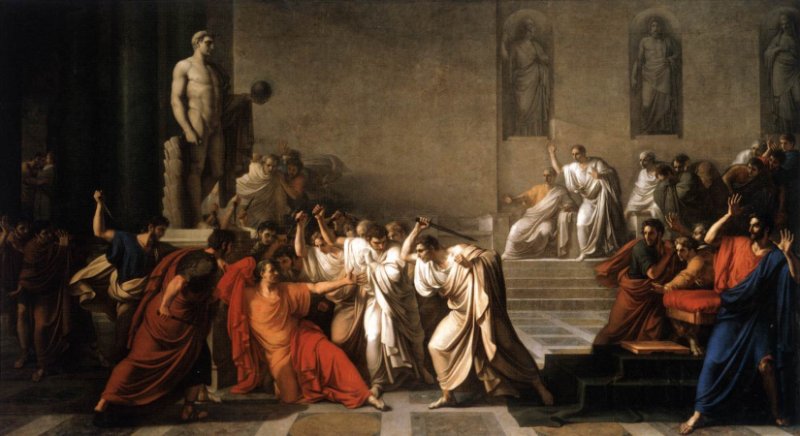
 Web Gallery of Art: The Death of Julius Caesar, Vincenzo Camuccini, 1798
Romans Lessons for America
There are major, thematic similarities going on in the U.S. today that are similar to the above dynamics concerning Rome. If left unchecked, the U.S. system could be in danger in several decades of collapsing as well, though not likely in as violent a way as the Roman Republic did. If this seems implausible, just remember how it took only a few decades for Rome’s republican institutions to cease to function and then crumble.
Three specific themes emerge. Firstly, there is the increasing role of money and big business in politics. In the U.S., elections are more often than not now determined by which candidate spends the most money. Like Rome, the increase in money has led to a narrowing of who can compete to hold office. The influence of this money especially buys large corporations, but also large unions, influence in the halls of power and their interests, not the people’s as a whole, are what are often considered. What is good or necessary for the country is not done. Halliburton’s donations gave it much influence, and resulted in it being awarded no-bid contracts where it was later found it had committed fraud and had overcharged the U.S. Government; in this sense, Halliburton, and others, are just modern publicani, their supporters in Congress no different than corrupt Roman senators. But the Bipartisan Campaign Reform Act (nicknamed “McCain-Feingold”) campaign finance law of 2002 is perhaps the best example of how loopholes undermine the best of intentions. The law itself has been basically struck down by the Supreme Court with its 2009 Citizens United v. Federal Election Commission ruling, itself a 5-4 decision split along partisan lines, but was already severely weakened by loopholes before that. Sen. Feingold lost his re-election, and Sen. McCain is becoming increasingly marginalized within his own party; there are other reasons besides this for each of their troubles, but it is important to note what is happening to the two men who did more than anyone else to attempt to change the role and scale of money in elections. Another major theme is the increase in the politics of personal destruction and partisanship. These forces saw a dramatic increase in the years of Bill Clinton’s presidency and have escalated ever since, especially during campaign season. Today, newly elected Republicans are speaking not of their agenda, but of stopping Obama. The level of personal attacks on candidates and the extent of distortion of an opponent’s record (Obama is apparently a Marxist revolutionary, a Muslim intent on imposing Islamic Sharia law, and is a foreign-born person ineligible to be president, just to list a few) are only increasing. This is making it harder for both parties to work together. And procedures, like introducing amendments or placing nominations on indefinite hold, have become hijacked for blatant partisanship in an increasing fashion. Clodius would not find himself totally out of place in today’s climate, save for his violence. Another theme is that of the rise of obstructionism and paralysis. Different factions are not trying to work together, they are trying to stop the government from functioning when something one faction does not like is being adopted or likely to be adopted, though, unlike Rome, this has not turned into a violent process. Whether out of genuine disagreement or a desire to prevent the other side from reaping credit, Congress has done little to tackle long-term problems at all in the last several decades while America’s schools, health system, infrastructure, entitlement programs, and debt/deficit (just to name a few) were all facing massive problems which grew steadily worse and are making life as Americans know it unsustainable. Such obstructionism, from filibusters or other tactics, was common, too, in Rome, and contributed significantly to the long list of massive problems that festered due to government inaction. The change in money and corporate involvement, tone and tactics, and the increase in obstructionism and paralysis are all feeding each other, and threaten to undermine the ability of the system to function not only well, but at all. These dynamics will undermine America’s government and Constitution without the personal warlord armies of Caesar or Pompeius, Marius or Sulla being necessary. The example of Rome should infuse American policy makers with even stronger motivation to tackle these three major challenges before the damage is too great. Unless major action is undertaken, the whole American system might find itself caving in on itself under the weight of these three problems and their amplifying effects.
Yet there is also one broad, societal theme: the general lack of restraint that is ever more present in American culture today. There is little else to be said about that: either Americans—individual citizens, government, society, and private enterprise—exercise more restraint, or three specific trends discussed above will doom America to destroying itself. Whatever the reforms were passed, corruption, and corrupt people, found a way to circumnavigate them in Rome. The U.S. is having the same problem today: laws and regulations are not something to be respected and observed in the U.S., it seems, so much as they are obstacles to be creatively bypassed or changed with the right amount of money thrown at the right number of senators and congressman. CEOs, senators, individuals, and presidents all reach beyond constraints regularly, whether legally, financially, morally, or procedurally established. If America keeps finding ways to reward, rather than punish, such behavior, it will find itself in a similar position to Rome in the twilight of its republic: the reckless, high stakes gambling will become so commonplace and accepted that few with the opportunity to push the limits of acceptable behavior will ever refrain from doing so. Individuals may spend, living for the moment, with reckless abandon; corporations may treat their customers as prey, to be bled dry for maximum profit for the company; government officials may tell people what they want to hear so they can be reelected and see to their own personal interests through the benefits of office; society as whole might not questions its own behavior and focus on short-term material gain, greed, glamour, unsustainability, personal success at all costs, and selfishness as “values” it demonstrates and passes onto the next generation. When such behavior becomes too common, then the U.S. will be like the republic Caesar described, “nothing—just a name, without substance or form.”
Only a few decades after Rome had formally turned most of the Mediterranean into provinces administered by the Senate, the very system which had brought it to dominate a large portion of the world collapsed suddenly and violently, though the symptoms of its fatal disease had been present for at least a generation if not more. One should shudder when one thinks that Rome had centuries of a tradition of no political violence at home, to only, in mere decades, episodically resemble some of the scenes common in sub-Saharan African cities, even with no history of such behavior. For the U.S., the ugly specter of anarchy appeared, though only very briefly, in the wake of Hurricane Katrina, and in the past, riots and disturbances were even more commonplace. The United States today, only two decades after the end of the Cold War, found itself on the brink of financial ruin and even still has an unsustainably massive and expanding deficit and debt, this only a few years removed from the booming years of the 1990s; its parties for decades have been unable to come together to deal with debt and many other major issues from immigration to education to social security, and the fact that Rome’s republican system of representative government and checks and balances collapsed on itself so soon after its total dominance of the Mediterranean should provide a stark warning for America: partisanship and obstructionism that delays tackling essential issues and lets them fester can bring down even the mightiest and most successful nation rapidly, and when corruption geared towards money and power substitutes for true patriotism, when leading elites seek to serve themselves and not the people, when a whole society loses its restraint and self-control, change can come rapidly in such a way that even a political system like America’s, based very much on Rome’s, might become mere history, one of Livy’s lessons from which a future power can learn “from it…what to emulate, from it what to avoid.” It is now for the republic of the United States to learn from the republic of Rome’s example, or to become mere history like it, another tragic morality tale in the dustbin of history.
See related eBook: The Ancient Roman Legal and Political Legacy in the Founding of America

The most powerful nation on earth, is relied upon by most regions of the world! Playing a very dangerous political game of obstructionism ,self interest, and a refusal to work for the long term benifits of people and country! I can only hope that the people elect better deligates and not those who’s interest is self preservation! And not to allow history to repeat itself..
You’re right that pure democracy brought down Rome, Gribbon chronicled that back in 1776 (The History of the Decline and Fall of the Roman Empire).
THANKFULLY we’ve never had pure democracy and never had any popular movement that pursued it. Franklin, one of the most influential Founders rightly described a pure democracy as “$ wolves and a sheep deciding on what’s for dinner.”
That’s why ALL 50 states, regardless of size/popl have the SAME # of Senators and why the Electoral College votes in the President, etc. America’s Founders rightly feared pure democracy, being as ALL of them were from among the most vulnerable and despised minority…that of wealthy, land-owners.
So long as we avoid Rome’s most critical mistake, forsaking the Republic for a pure democracy, we’ll remain free and strong.
I do hate this type parsing words regarding Republic v Democracy.The founding fathers would not want the pitiful “Democracy” (or whatever the hell you want to call it) that the US has today. I will let the founding fathers respond. http://stupidpartyland.com/founding-fathers-loathe-stupidparty
Author here. Sorry to be a nudge, but Rome never became a pure democracy!!