Notwithstanding Trumps efforts to take us back to the dark ages, there are many amazing things happening – the best perhaps being the imminent end of the ice age – the death of the Internal Combustion Engine
Part 3

See Parts 1, (the context) Part 2 (the Greatest American is…)
In part 2 I revealed the greatest American and in part three I will justify the choice by taking you into the near future—in which one can see America sitting back on that shining hill—or will it be a fading mirage?
Fossil Cars for Fossil Fools will soon belong to the Dinosaur era. First imagine the year is 2022 and we are taking a trip down memory lane.

The above is hardly a comprehensive list of relics from a bygone era:

Oh and what is left? What will be next to go?
Side mirrors,
Instrument panels,
The drivers,
A second car,
Massive parking areas,
Gas stations,
Why have a Car?
90% of cars in the world at any given point are doing nothing. Yet you are carrying the cost of depreciation, of Insurance, of space, of time and money in cleaning, maintenance and repair–with the constant need to go to gas stations, stuck in traffic with numerous others doing equally redundant exercises.
In many Countries now, transportation choices are changing rapidly, especially in urban areas. As early as 2016-17 Singapore is slated to having driver-less “pods.” Once one City can show success, other City’s will just look silly if they do nothing. In the UK the number of men under 20 seeking a driving license has fallen by 72%. In just one year in Britain, the percentage of 17 to 20 year-olds with driving licenses fell from 48% in the early 1990’s to 35% last year.
As The Guardian reports; “Young people today would rather have the latest smartphone than a flashy car. And the number of them who can drive is plummeting. Is Britain’s love affair with the car really over?”

Parents reliving their own adolescent dreams hurry to pass on the same dream to their kids, oblivious to the fact that kids, while not wanting to bite the hands that feed them, are hardly thirsting for this economic anchor. For today’s kids, ever smarter phones are indispensable, they are well-trained not to drink and drive, always have a designated driver, gotten used to shared rides, to “UBERring it”—and just use their parents cars when they do actually need a car.
OK—so let us look at what the naysayers will say:
More expensive than a Fossil Car ?
In 2016—yes EV’s on paper remain expensive to buy (if you forget a, long term cost of ownership, costs of pollution, global warming, costs of oil inspired wars, etc.
But within five years this rather feeble argument will be turned on its head. Let me explain the math (since I am no engineer this will be kept real simple, I really hope that I am not being too simplistic).
As I understand it, the following statements are all true.
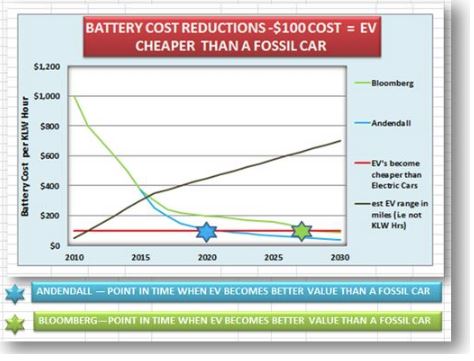
- The cost of a battery until recently has been about $1,000 per Kilo Watt hour.(Kw/h)
- People have being saying that if this cost were to fall to about $100 per Kw/h –that would signal the end of the fossil engine.
- Government projections had assumed that a target of $200 per Kw/h would not be achieved until 2040.
- The Tesla Model S–Kw/h cost is now only $190. GM claims a number of $145–but I believe their battery is a different and less dynamic Lithium ion effort.
- The new Gigawatt battery facility will likely bring down the cost dramatically in time for the Model 3—end of 2017 $124?
- $100 and then less by 2019?
Notes about above chart
- data for 2010-2015 from Bloomberg
- data for 2016 based upon Tesla comments about the Model S
- projection for 2017 – based upon latest hints dropped by Elon Musk re the Model 3 Nevada Gigafactory Savings projected for 2nd half of 2017
Now very few people had been expecting this type of progress–thus all articles about EV viability, and the projected end times for fossil cars are suddenly obsolete.
But it only gets worse for old fossils. Your average fossil car gets slightly more expensive every year. But this will not sit well considering EV’s will get significantly cheaper every year.
Let’s do the Math.
We will take the Tesla Model S 90 Kw/h. At present the battery costs $250 x 90 = $22,500. Well in 2021, this cost is likely to come down by half, plus economies of scale will allow other parts and fixed costs to come down dramatically.
Will the Model S 90 cost less? No, because it will be discontinued and its replacement will soon (i.e. around 2022-24) have a range of 600 miles and do 0-60 in 2.5 seconds (this could happen far quicker -basically any time)
Range anxiety–Long stops at recharging stations:
Another concern is range anxiety and wasted time spent at supercharging stations:
In the near future EV’s will likely have a range of 300-400 miles.
Presently on average an American stops in at a garage once a week for an average of 10 minutes a pop. 500 minutes a year.
But EV owners will be recharging at home virtually all the time. Yes on the few occasions when they travel more than 300-400 miles on a single trip they might need to stop for 30 minutes. On such trips they would likely need a bathroom /coffee break regardless. But assuming no such desire and that such trips happen 10 ten times a year–such drivers will still save 200 minutes year by bypassing gas filling pit stops.
Cost of ownership:
It has been variously estimated that the 5-10 year $70,000 Tesla Model S has a similar cost of ownership to cars costing less than $35,000–it would be fair to state that the cost of ownership for the $35,000 Model 3 will be half of the cost of an average fossilized car.
Old Batteries will be hard to dispose of and cause pollution:
This is rapidly becoming a myth. I say this by making the following assumptions.
- We are discussing Lithium Ion batteries.
- Such batteries have a 10 year(?) useful life (in a car –so long as they retain 80% of their original integrity)
- It is presently presumed that this integrity can be maintained for at least 250,000 miles. Musk evidently plans to stretch this to 1,000,000 miles
- Once such a battery has reached an end to its useful life in a car, it can then be re-purposed for more utilitarian tasks – such as a storing solar energy for use at night.
- Once that “million miler” battery has become inefficient at the above task it can be recycled, the key materials separated and then used again.
Detroit has the infrastructure and money to swamp the new order:
Putting aside that the taxpayers until recently owned much of Detroit; this argument is past its sell-by date. Tesla is now valued at say 50% of General Motors, although Tesla’s production is but a tiny fraction.
A typical naysayer was to say of this dynamic:
“However, this is not a Prius, and the masses will not be owning a Tesla anytime soon. The average price for a Tesla Model S is listed at MSRP levels of $71,070 to $94,900. That hardly fits the budget of most working Americans”.
This was said over a year ago–but surely you can now see just how unimaginative orthodox punditry is.
Chevy will soon be releasing its masterpiece—the Bolt. If they had done this 15 years ago, and done it in such a fashion as to threaten their core products—then they would not be a laughing stock.
As The Business Insider explains:
General Motors Bolt is DoD (Dead-on-Departure), and General Motors should just cancel this project; completely misses the mark with the iPhone generation consumer “It’s An Ugly Tiffin Box”
- Digitally centered consumer is sick and tired of General Motors, BMW, Mercedes, Audi, Toyota etc. and almost every existing Auto manufacture who have shown zero innovation and have been producing “Ugly Tiffin Boxes” for decades
- Tesla Model 3 has been designed for the iPhone generation consumer, whose lives are digitally super-centered—and competition is completely clueless—somehow it seems that existing auto manufacturers believe that iPhones can be powered by Gasoline and not Batteries

Tesla has the momentum, the Car factory, the battery factory (almost) and most importantly the brains. Talking about brains, Apple and Google both have more money than god, and more brains than all the fossils combined. They are now on the case. Detroit has always been a laggard compared to the Germans and Japanese–but now America is strategically set to be the driving force, but that will require new drivers.
The last of the fossil arguments—why should I pay for the $7,500 tax credit for other people?
Well this is the argument I will get most joy in eviscerating, and doing it in a way that few other people will have the balls to do. I can make this argument because I have believed, with every fiber of my being–all through my adult life, what we all should have been doing for the last decades. The facts have long since proven that I am right. So this is my response to such old fossils:
Why have you been allowed to drive a fossil vehicle free of the consequences of your demand for such a vehicle? Why should you not pay for the costs you create in creating an unnecessary demand for oil–that achieved the following:
- Drives up the cost of oil
- Pollutes the planet, spewing sickness, and inducing smog
- Exacerbates global warming
- Enriches humanities enemies whether it be in the Middle East, or the Russian, or those in the Stupidparty congress.
- Creates oil wars, creates religious fundamentalism, creates terrorism
Jimmy Carter spelled this all out back in 1977. If you chose not listen to the obvious, then how dare you complain if some of your tax dollars get used to clean up the mess you created. Only bad people, or very uninformed people could possibly be walking around without a feeling of huge guilt.
But of course this (whining about the tax credits) is an old fossil argument–because by 2021–not only will such subsidies be ancient history, but they will no longer be necessary. There will be no point in flogging a deadbeat fossil mode of transport into the ground as it will have driven itself to the knacker’s yard on its own humiliated horsepower.
Good bye and good riddance!
And now for the “worstest” American
See Parts 1, (the context) Part 2 (the Greatest American is…)
In part 2 I revealed the greatest American and in part three I will justify the choice by taking you into the near future—in which one can see America sitting back on that shining hill—or will it be a fading mirage?
Fossil Cars for Fossil Fools will soon belong to the Dinosaur era. First imagine the year is 2022 and we are taking a trip down memory lane.

The above is hardly a comprehensive list of relics from a bygone era:

Oh and what is left? What will be next to go?
Side mirrors,
Instrument panels,
The drivers,
A second car,
Massive parking areas,
Gas stations,
Why have a Car?
90% of cars in the world at any given point are doing nothing. Yet the consumer is carrying the cost of depreciation, of Insurance, of space, of time and money in cleaning, maintenance and repair–with the constant need to go to gas stations, or the mind numbing stupidity of being stuck in traffic (where ones brain might actually die or at least be permanently scarred by the entrapment of abhorrent talk radio) with numerous others doing equally redundant and dangerous exercises.
In many Countries transportation choices are changing rapidly, especially in urban areas. As early as 2017-18 Singapore is slated to having driver-less “pods.” Once one City can show success, other City’s will just look silly if they do nothing. In the UK the number of men under 20 seeking a driving license has fallen by 72%. Just recently in Britain, the percentage of 17 to 20 year-olds with driving licenses fell from 48% in the early 1990’s to 35% last year.
As The Guardian reports; “Young people today would rather have the latest smartphone than a flashy car. And the number of them who can drive is plummeting. Is Britain’s love affair with the car really over?”

Parents reliving their own adolescent dreams, hurry to pass on the same dream to their kids, oblivious to the fact that kids, while not wanting to bite the hand that feeds them, are hardly thirsting for this economic anchor. For today’s kids, ever smarter phones are indispensable, they are well-trained not to drink and drive, always have a designated driver, have gotten used to shared rides, to “UBERring it”—and they just use their parents cars when they do actually need a car.
OK—so let us look at what the naysayers will say:
More expensive than a Fossil Car ?
In 2016—yes EV’s on paper remain expensive to buy (if you ignore the long term cost of ownership, the societal costs of pollution, global warming, of oil inspired wars, etc).
But within five years this rather feeble argument will be turned on its head. Let me explain the math.
As I understand it, the following statements are all true.
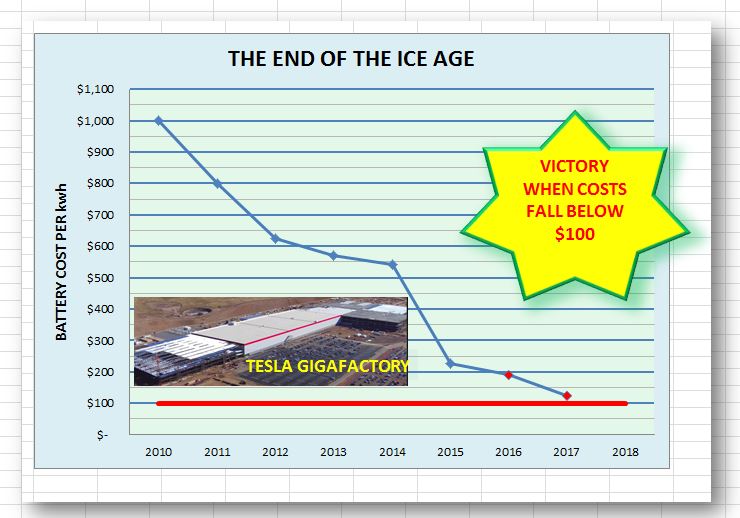
- The cost of a battery until recently has been about $1,000 per Kilo Watt hour.(Kw/h)
- People have being saying that if this cost were to fall to about $100 per Kw/h –that would signal the end of the fossil engine.
- Government projections had assumed that a target of $200 per Kw/h would not be achieved until 2040.
- The Tesla Model S–Kw/h cost is now only $190. GM claim-a number of $145–but I believe their battery is a different and less dynamic Lithium ion effort.
- Tesla’s Gigawatt battery facility will likely bring down the cost dramatically in time for the Model 3—end of 2017, to around $124?
- $100 and then less by 2019?
Notes about above chart
- data for 2010-2015 from Bloomberg
- data for 2016 based upon Tesla comments about the Model S
- projection for 2017 – based upon latest hints dropped by Elon Musk re the Model 3 Nevada Gigafactory Savings projected for 2nd half of 2017
Now very few people had been expecting this type of progress–thus all articles about EV viability, and the projected end times for fossil cars are suddenly obsolete.
But it only gets worse for old fossils. Your average fossil car gets slightly more expensive every year. But this will not sit well considering EV’s will get significantly cheaper every year.
Let’s do the Math.
We will take the Tesla Model S 90 Kw/h. At present the battery costs $250 x 90 = $22,500. Well in 2021, this cost is likely to come down by half, plus economies of scale will allow other parts (far fewer parts are required) and fixed costs to come down dramatically.
Will the Model S 90 cost less? No, because it will be discontinued and its more luxurious replacements will soon (i.e. around 2022-24) have a range of 500 miles and do 0-60 in 2.5 seconds (this could happen far quicker -basically any time). Update: The performance Model S can actually do better than 2.3 seconds -and when Musk gets round to re releasing the much lighter two seat Roadster -he will have little problem besting 2 seconds.
Range anxiety–Long stops at recharging stations: (updated Sept 2017)
Another concern is range anxiety and wasted time spent at supercharging stations:
In the near future EV’s will likely have a range of 400-500 miles. The Tesla Model S 100d is already at 335 – and that is using it’s older battery technology.
Presently on average an American stops in at a garage once a week for an average of 10 minutes a pop. 500 minutes a year.
But EV owners will be recharging at home virtually all the time. Yes on the few occasions when they travel more than 300-500 miles on a single trip they might need to stop for 30 minutes. On such trips they would likely need a bathroom /coffee break regardless. But it is far more likely that such trips happen 10 times a year– and future charging times will fall by 50% to say 20 mins a pop, such drivers will still save 300 minutes a year by bypassing gas filling pit stops.
Once such accelerated charging times occur, this will be the final nail in the ICE coffin – expect further clarity about charging times when the specifics come out on the Tesla Model 3, by spring 2017— and its guidance re the 2170 battery technology. Musk has hinted that Super Charging capabilities will change from up to 145 kW of power distributed between two adjacent cars, with a maximum of 120 kW per car – to a new max > 350 kW of power.
Here is the latest Tesla Supercharger network. Red=Existing, Grey= by the end of 2018 and Black= existing Destination Chargers

What high speed convenient locations do the fossil encrusted competition have?
Well is seems that the GM Bolt will send you to a third party vendor, a vendor that is not married to the Bolt consumer, with less convenient locations, slower recharge times –

If you buy a Bolt – or any other likely new competitor in the next few years – they are not likely ready for prime time when it comes to habitual long distance driving. “Clean Technica” reports:
- The fastest non-Tesla EV fast-charging stations out there can charge a ~200-mile electric car like the Chevy Bolt (if it has the capability) from 0–80% in approximately 1 hour, or 30–80% in approximately 35 minutes.
- Driving for a couple of hours, and then charging for an hour, and then driving for a couple of hours, and then charging for an hour, just isn’t a convenient way to take a road trip. The story is probably even less convenient if you are stopping at shorter intervals to charge due to charging stations not being widespread enough to be placed exactly where you want them.
- Tesla Superchargers are up to 120 kW in output capacity, and can thus charge a Tesla approximately twice as fast as the fast chargers noted above.
Cost of ownership: (Updated Sept 2017)
It has been variously estimated that the $70,000 Tesla Model S has a similar cost of ownership to cars costing less than $35,000–it would be fair to state that the cost of ownership for the $35,000 Model 3 will be almost half of the cost of ownership of an average fossilized car. The five year cost of ownership of a typical new $35,000 Car will on average be $49,000???. Say this can not be so…

Clearly such costs will soon be out the window – virtually no new drivers will be remotely interested in blowing $10,000 a year – especially with all the new transport options rapidly coming on tap. Now think about the Model 3 with its million mile life expectancy, minimal fuel costs, minimal servicing costs. I expect that the five year cost of ownership for a model 3 to be around $20-25,000. This number will drop dramatically once the auto pilot properly kicks in – creating a very significant reduction in Insurance costs. The longer one keeps the model 3, the more miles you drive the model, the wider the gap. Want proof? A car rental Company “Tesloop” has the numbers for a Model S -creating savings of say $60,000 over 300,000 miles compared to its peer group. On the one hand this number is a bit unfair in that this Model S gets free Supercharging for life -but this aspect is more than offset by the fact that this Model S is no where near it’s life expectancy – where as any peer group car would now need to replaced. Clean Technica reports:
“If this sounds like an insanely low maintenance and fuel cost for 300,000 miles of driving, that’s because it is, especially for a car in this class. “Had this been an Mercedes S class, the scheduled routine maintenance and fuel would have been $86,000 ($52,000 maintenance and $36,000* fuel) with 112 days of servicing, or for a Lincoln Town Car $70,000 ($28,000 maintenance and $42,000** fuel) with around 100 days of servicing,” Tesloop writes. The Tesla Model S was in the shop for just 12 days.
Also, it’s good to see this quote from Tesloop founder Haydn Sonnad, indicating that the faith he placed in Tesla has been paying off beautifully:
“Over the last two years, we have seen that electric, supercharged vehicles can be deployed at utilization levels unheard of with gas vehicles. And while saving over $60,000 on fuel and maintenance is a substantial economic win, we feel the bigger win is that this car is ready for another 900,000 miles over the next 6 years under its current warranty. A gas car with 300,000 miles would be near the end of its useful lifespan. This means that the economics for mobility services on electric is more attractive than non-electric vehicles by a multiple, and when combined with autonomous driving features, the economic advantage in cost per mile will create unprecedented disruption in the overall automotive industry.”
Old Batteries will be hard to dispose of and cause pollution:
This is rapidly becoming a myth. I say this by making the following assumptions.
- We are discussing Lithium Ion batteries. Such batteries have at least a 10 year(?) useful life (defined as— so long as they retain 80% of their original integrity)
- It is presently presumed that this integrity can be maintained for at least 500,000 miles. Musk evidently plans to stretch this to 1,000,000 miles
- Once such a battery has reached an end to its useful life in a car, it can then be re-purposed for more utilitarian tasks – such as a storing solar energy for use at night.
- Once that “million miler” battery has become inefficient at the above task it can be recycled, the key materials separated and then used again.
Detroit has the infrastructure and money to swamp the new order:
Putting aside that the taxpayers until recently owned much of Detroit; this argument is past its sell-by date. Tesla is now valued at say 50% (actually now 100%- updated) of General Motors, although Tesla’s production is but a tiny fraction.
A typical naysayer was to say of this dynamic:
“However, this is not a Prius, and the masses will not be owning a Tesla anytime soon. The average price for a Tesla Model S is listed at MSRP levels of $71,070 to $94,900. That hardly fits the budget of most working Americans”.
This was said over a year ago–but surely you can now see just how unimaginative this orthodox punditry was.
Chevy will soon be releasing its masterpiece (updated: this has now happened, with not much of a spark)—the Bolt. If they had done this 15 years ago, and done it in such a fashion as to threaten their core products—then they would not be a laughing stock. GM continues to lobby against EV’s -across the world including, China – and while this will gain traction politically under Herr Twittler Trump -it will fail globally. So screw you GM and your fig-leaf of a Bolt. When the tide turns, we will remember, and we will watch you drown in your own pre-historic garbage.
As The Business Insider explains:
General Motors Bolt is DoD (Dead-on-Departure), and General Motors should just cancel this project; completely misses the mark with the iPhone generation consumer “It’s An Ugly Tiffin Box”
- Digitally centered consumer is sick and tired of General Motors, BMW, Mercedes, Audi, Toyota etc. and almost every existing Auto manufacture who have shown zero innovation and have been producing “Ugly Tiffin Boxes” for decades
- Tesla Model 3 has been designed for the iPhone generation consumer, whose lives are digitally super-centered—and competition is completely clueless—somehow it seems that existing auto manufacturers believe that iPhones can be powered by Gasoline and not Batteries

Tesla has the momentum, the Car factory, the battery factory (almost) and most importantly the brains. Talking about brains, Apple and Google both have more money than god, and more brains than all the fossils combined. They are now on the case. Detroit has always been a laggard compared to the Germans and Japanese–but now America is strategically set to be the driving force. How ironic is that -that the one Country in the world that officially wants to promote Global Warming, can yet be the Country to save humanity from it’s own hubris.
The last of the fossil arguments—why should I pay for the $7,500 tax credit for other people?
Well this is the argument I will get most joy in eviscerating, and doing it in a way that few other people will have the balls to do. I can make this argument because I have believed, with every fiber of my being–all through my adult life, what we all should have been doing for the last decades. The facts have long since proven that I am right. So this is my response to such old fossils:
Why have you been allowed to drive a fossil vehicle free of the consequences of your demand for such a vehicle? Why should you not pay for the costs you create in creating totally unnecessary demand for oil–the consequences of such a myopic outlook have been the following:
- Drives up the cost of oil. (deh)
- Pollutes the planet, spewing sickness, and inducing smog
- Exacerbates global warming
- Enriches humanities enemies whether it be in the Middle East, or in Russia, or those who finance the Stupidparty congress. (Oh yes, how else do you explain how educated politicians can deny global warming, other than by corruption?)
- Creates oil wars, creates religious fundamentalism, creates terrorism.
Jimmy Carter spelled this all out back in 1977. If you chose not listen to the obvious, then how dare you complain if some of your tax dollars get used to clean up the mess you created. Only bad people, or very uninformed people could possibly be walking around without a feeling of huge guilt.
But of course this (whining about the tax credits) is an old fossil argument–because by 2021–not only will such subsidies be ancient history, but they will no longer be necessary. There will be no point in flogging a deadbeat fossil mode of transport into the ground as it will have driven itself to the knacker’s yard on its own humiliated horsepower.
Good bye and good riddance!
And now for the “worstest” American

Leave a Reply