But there are plenty of things that you do need to care about.
Generally when I write blogs, I avoid irritating anyone who is not among the 67%. So it is with trepidation that I find I must try and rectify much pain and suffering that I have endured whilst living in America—connected with cultural disconnects surrounding sports.
The thesis I put forward will appear to be a British-centric view. But that would be wrong, since what I am about to try to explain would not be understood by British sports fans. Brits have a huge sporting chip on their shoulder that is 100 percent of their own making. Few Brits would regard Britain as a great sporting nation. The reason for this is simple—I would guess that about 80 percent of all sports attention revolves around soccer. This infuriates me, not simply because I am not a great fan of soccer, but because England is crap at soccer—and will remain crap for the foreseeable future.
English soccer fans get excited when they beat countries that are so small I wonder whether every eligible male that can kick a ball makes it into that country’s national team. England loses to such countries as Iceland, gets excited by beating Croatia 1–0. Why do we even bother? The premier league is simply a bunch of mercenaries imported from the continent. If you would like to understand how I view soccer, well, Mitchell and Webb can explain.
But being an equal-opportunity “offender,” I must now turn my guns on the USA. As much as I dislike soccer, I dislike American football even more (although its short season should be a lesson to all, but I digress). I want to make a more fundamental point: when it comes to sports, America is a lonely Island—but yet it remains oblivious to this isolation. Some of the comments I am going to make will never be understood. This always has me scratching my head. The best analogy of my loneliness in my knowledge on certain rather specific aspects would be the pivotal issue of tea. Sometimes the simplest things just cannot be culturally grasped. How difficult can it be to only use fresh boiling water on top of a proper tea bag, rather than putting a Lipton’s tea bag into hot water? Every time I see am American drink a cup of tea not made with boiling water, I find myself tortured.
Having a multicultural viewpoint, an ability to triangulate cultures, can be really frustrating when a specific culture is stuck in a parochial void, for example, watching an English consumer tolerate nonexistent customer service. In the US no one can see my inner pain when I watch strapping guys playing backyard versions of that game (American football), which simply amounts to throwing a ball and having someone catch it (boring). This is far far less fun than playing garden rugby—where you can get down and dirty in no time, walk away bruised and fulfilled. My real beef comes down to how uninvolved America is with international team sports. It is this vacuum that means the USA is simply not the best sporting nation in the world.
It can now be argued that basketball is an international team sport—but I don’t actually buy that, and also I do not want to get into it. However, if you are eight feet tall and weigh 350 pounds, how tough can it be? Shaquille O’Neal had an extremely low shooting percentage, but why bother if you can just Sherman Tank it to the basket and pop it in the net?
Obviously, soccer is by far the biggest international team sport. Americans can argue that American women are great—yes, they are. But here is the thing—America through college has almost as good soccer infrastructure as anywhere else in the world. But after that it dies. It is the game of choice for the largest group of parents, and a great participation sport for the whole team. Yes, two or three times a year Americans may tune into soccer to watch their women—but sadly the rest of the world tunes in 360 days of the year. Lack of time-outs kills the sport in the USA.
My Big Beef—American Football

This sport is just a handout to the billionaire owners, who constantly mooch off the taxpayers/fans. The insults just get worse and worse. These owners are not mostly interested in the sport; they are mainly in it for the massive profits they get to pocket, and that their bought-off congressmen ensure remain largely undertaxed, via a variety of loopholes and accounting gimmicks that are so zealously protected by a corrupted Congress and halfwits like Joe the Plumber. So what is their game? How do they extract even more from the poor, suckered taxpayers?
Now, sit down and imagine you are going to spend the next three or four hours watching an NFL football game. Hidden behind all the noise and fanfare, all the ads and product placements, hidden behind that is the hallucination that you are there to watch a sports event—the mirage of sports, the biggest trick of them all. During this 3–4 hour time span the NFL and its owners will provide you, the taxpayer fan, with less than 11 minutes of live action. Now, to put this into perspective (since perspective has been long gone), the world’s most popular sport, which we have to call soccer, has two halves of play, each with 45 minutes of uninterrupted play—for 90 minutes of action.

Ironic that a publication that is a tool of the new American order is the source of this data. NFL is the richest sporting league in the world, with an annual average revenue in excess of $6 billion, where players are multimillionaires. Out of the 32 NFL teams, 26 owners are billionaires—thus making the total valuation in excess of $25 billion.
Forbes Magazine Explains:
While the league office is run as a not-for-profit “trade association promoting [the] interests of its 32 member clubs,” all but one of those clubs are privately held, for-profit companies that reveal next to nothing about their finances.
The 31 privately held teams keep their finances shrouded in mystery.
So what have these owners—these proven moochers—done to American sports? American football has 6 percent action time, soccer 78 percent. The most similar non-USA game would be rugby, which is a more popular sport; it has 84 percent action time. A soccer player runs on average about 7–9 miles per game, a rugby player 5 miles, and an American football player 0.2 miles.

The Final nail in the Coffin? (Of course not.) The NBA is seriously talking about reducing the game time from 48 to 44 mins—thus invalidating the whole history of stats—and look at the justifications being promulgated. At an NBA coaches’ meeting, length of games was a topic, and it was suggested the NBA consider a shorter format that would reduce the length of game (a game massively inflated by time-outs) as a means to reduce minutes for some players and maybe improve the flow of the game.
Did they really say that? You have got to be kidding.
But yet Americans have not even noticed or seriously wondered why they do not really participate in international team sports. After soccer you have rugby union (a game massively superior to American football: far more action; far more interesting having two nations playing against each other than two towns or sometimes teams from the same city)—again, rugby has a pretty impressive college infrastructure in the USA these days, but lack of time-outs dooms the sport after college. After rugby union there is rugby league. Somewhere in the top three or four international team sports lies the massively misunderstood game of cricket. In this case adverts on an epic American scale would be possible, but the game is too complex for the limited attention spans of today’s sports fans. The game is so much more three-dimensional than baseball—things that baseball lacks determine strategy:
- the importance of the atmospheric conditions
- the quality of the playing pitch (there are no properly prepared grounds or pitches in the USA)
- predicting how the weather and the pitch will change over time
- the state of the ball, which changes character as it ages through the day (it is thus vital that the ball must be returned by the crowd)
- the ability to catch the ball without wearing that silly (except for the catcher) mitten
- the craftsmanship involved in making the cricket bat (and ball)
- the courage, endurance, and massive long-term concentration required of a batsmen (hitting the batsman is allowed)
- determining the pace of play—playing for a win may be a losing strategy. A draw could be a win
- playing international cricket is the driving force behind all aspiring players
And so much more. A friendly game of backyard cricket is a far better social event than an equivalent baseball game—the non-batting participants (i.e. only the fielding side needs to be fully on duty) can mainly mingle and linger in conversation, without the constant back-and-forth of baseball. The game nowadays can also be condensed to a similar time frame as baseball.
Because American athletes have such expensive contracts with their town, owners cannot allow the players to play for their country (as a general rule), whereas elsewhere, playing for one’s country is all that matters. Playing for one’s country requires citizenship; playing for a city requires zero connection. If you are good enough to play at an international level, then the players are paid via a central contract, which is more lucrative than a local contract. This does not apply to soccer. Yet in spite of massive contracts, no one would dream of preventing a player from playing at an international level. Even in America, the sporting events that are most memorable for the fans—for golf it would be the Ryder Cup, a far better spectator event than following some random player around—are international, such as when America beats Russia in ice hockey, America tops the Olympic games, American women’s soccer players beat Norway or Germany. Not when the Podunk Tigers beat the West Islip Lions.
Then there are international sports that America destroy (domestically) singularly and without apparent reason. Take squash—Americans play on a slightly smaller court with a faster ball. WHY!!!!!! Nascar vs. Formula 1—talk about a circular argument. America, by not being part of the Commonwealth because they refuse to take the knee to the Queen, misses out on one of the biggest international sporting events, the Commonwealth games—with 4,500 athletes (the Olympics by comparison have 10,000 athletes) and 71 nations. 1.5 billion watched the opening ceremony. How is that whole Independence Day thingamajob going for ya right now? The fifth-biggest sporting event in the world is the Grand National—which while admittedly is not international; it is by a massive margin the best horse-racing spectacle ever devised.
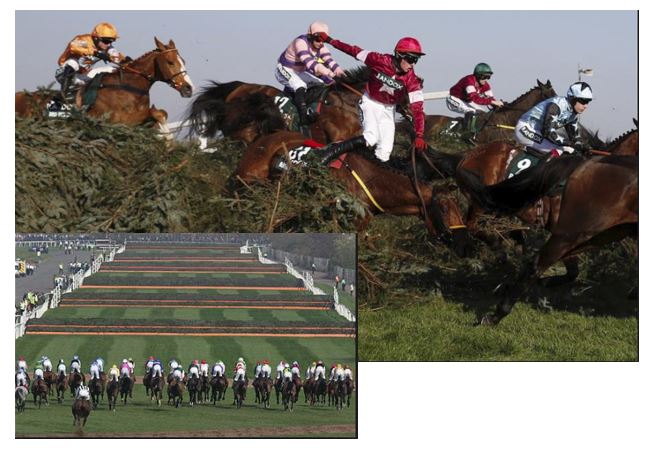
Grand National at almost 4.5 miles long, 30 fences. Kentucky Derby by comparison is 1.25 miles.
Playing sports is even more fun (and healthy) than merely watching. You hear of people (in all countries) so consumed by sports that they cannot leave their couch or iPhone, can not engage in standard conversation with those around them—lost on their own Island. Boring! Meanwhile with zero preparation or expertise Trump has just gone solo and surrendered all American interests and leverage in his peace talks with N.Korea acting on advice from Putin—but hey look the Hokey Dokeys have just won the Stanley Cup, the perpetually losing Mets (with their randomly situated blue stadium in a reclaimed swamp sandwiched between highways and airports) have their entire roster on the disabled list and their groundhog day fans think that life is so unfair. No Nukes today—must be a good day. Oxygen deprived brains. America great again. OK—so maybe Soccer induced brain damage helps explain Brexit—but certainly into these breaches the enemies of the West pour into.
Sport should be an asset not a liability. International sport breaks down barriers. We need more of that. Forcing the Prime Minister of India and President of Pakistan to spend five days watching a cricket game between the two countries has undoubtedly made them less keen to nuke each other. International sports—especially international team sports, or multi country events—these are vital cultural exchanges that Americans are starved of, oblivious to.
But back to those oxygen deprived subjugated fans, perhaps the key is participation in such sport. Approximately 45 percent of English adults (aged 17–75) regularly play sports. The comparable number in the USA looks like it sits at around 25 percent. So having a diverse sporting culture, not gutted by greed, not gobbling up every waking thought—has a huge impact on a country’s culture.
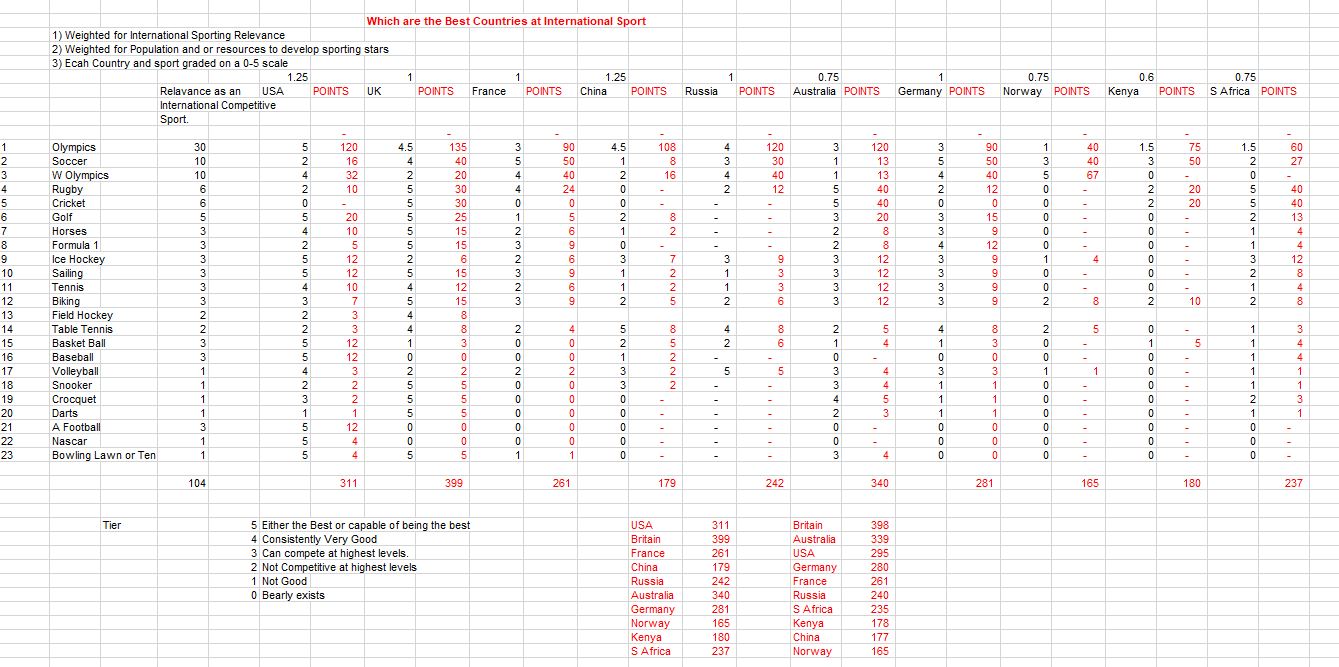
It is just so frustrating, viewing such issues from a multicultural perspective and witnessing the obliviousness. But now let us look at the numbers.
Americans are not the best sporting nation in the world. Guess who is. OK, I did cheat in one area—I will confess below the table.

I gave America football the same rating as snooker—1) just to piss people off, but 2) more importantly, to make a point: more nations play snooker than American football. Luckily, American football is in long-term jeopardy, as parents do not want their kids playing it anymore.
Below I rectify that slightly unfair weighting. I also give baseball and basketball a quite generous weighing of 3. None of this changes America’s position, at #3. Britain wins—and this is a result I had never really considered; it was actually not that important to me (I have a growing dislike of jingoism—especially in this era of rising nationalism). Britain #1? This is certainly not known amongst the Brits. I had always considered Australia the best sporting nation in the world—but they have gone downhill; one of the reasons being their fetish for Australian rules football, but at least this sport does not have a world series as their capper.

Leave a Reply