Gullibility—Our Secret Weapon
part 1 here
Suddenly the best storyteller became of vital import. Sheep would flock around
and start baa-baaing with, become submissive to, this “shepherd.”
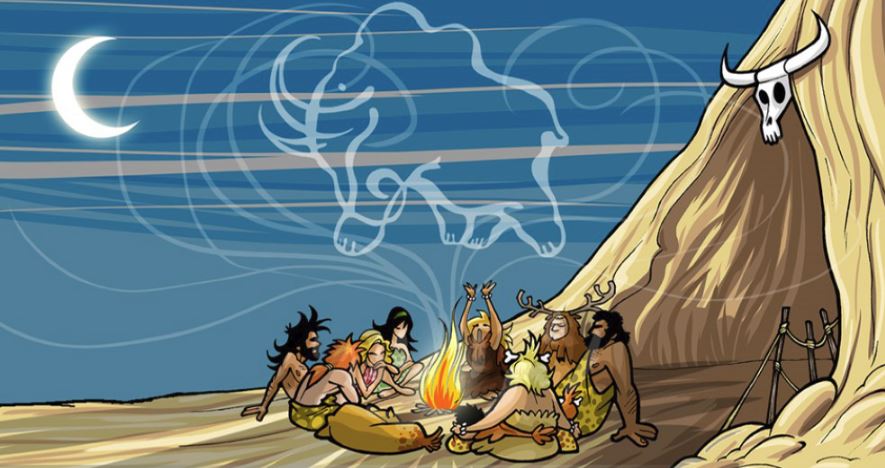
The tribe became a greater force—living, fighting, and dying for this almighty deity. It
might have been the Sun, the Moon, Mars, Venus, the Wind, the Water, their great
warrior ancestor, a snake, a pig, a horse, a lion (for those who struggle to spot a
pattern), or whatever floated their collective boat. It did not matter what or who it
was. This singular mythical belief system achieved what had never been achieved
before in the history of our planet—it got a group of primates to work as a collective
force in numbers greater than 150. That being the Dunbar number, which
hypothesizes that with the neocortex size we humans have, you cannot have more
than about 150 friends (people or primates) that you work well with, gossip to,
care about, or as the anthropologist Robin Dunbar put it, “with whom a stable
interpersonal relationship can be maintained.”
This ability to have larger societies caring for one another and fighting under a
common banner, for a common cause beyond mere survival, beyond the next
meal—that was what allowed Homo sapiens to reach the top of the food chain.
Homo sapiens beat out the Neanderthals, not because they were strong, smart, or
“wise” but because they were the more gullible. We are delusional to our core—
and that is my point.
Just because our very survival, our dominance, is the result of a collective Faustian
bargain—to be successful, one must be delusional (i.e., stop thinking for oneself,
lose one’s freedom to a collective)—does not mean we had to maintain that
bargain. At any time we could have set ourselves free. Theoretically, the turning
point—enlightenment for much of mankind—should have come right there in
Genesis, when Eve bit the apple, thus potentially setting mankind free (from
tyranny?). Or when Jesus asked us to reject the bad-tempered Old Testament eye-for-an-eye,
genocidal God by turning the other cheek and loving thy neighbor; or
when Darwin’s theory of evolution—that all life forms have a common ancestor—
proved infallible to well-informed attack.
But none of that came to pass. We are what our DNA tells us to be (although scientists in the field of epigenetics
suggest external or environmental factors can impact human development,
but not change gene sequencing). And the same way our DNA tells us to eat
more than we need (from our hunter-gatherer feast or famine days), our DNA
likewise encourages delusion by making us happy in make-believe—blessed,
ignorance-based bliss. It is a simple question we all face: do we take the blue pill
(ignorance) or the red pill (reality) wrapped in parsley to mitigate the stench of
delusion?
“Like the layers of an onion, under the first lie is another, and under that
another, and they all make you cry.”
Derrick Jensen, American author and environmentalist

Sure, the worse the reality is, the stronger the incentive for the blue pill. But this
is not a once-in-a-lifetime choice—it is a choice made hundreds of times a day.
The problem with the blue pill is that it’s addictive. As for those of us not addicted
to ignorance, we toil away, seeking solutions based upon facts, trying to make
sure those Onions don’t end up on the dinner table of a malevolent oligarch. Why
bother? Are we delusional too?
See Part 3 coming soon

Leave a Reply